


Starting a restaurant in Australia in 2026 is a serious commercial decision. Most operators should expect a total startup cost of around $250,000 to $1 million or more, depending on the size of the venue, location, lease terms, kitchen requirements, fitout standard, furniture selection and working capital.
The timeline is also longer than many first-time operators expect. From concept to soft launch, a realistic window is 6 to 18 months. Council approval, lease negotiation, equipment lead times, liquor licensing, staff recruitment and furniture ordering can all affect your opening date.
At Cafe Solutions, we work with hospitality operators who are planning the front-of-house side of their venue, including restaurant chairs, tables, table tops, table bases, bar stools and other commercial furniture. This guide gives you the full restaurant startup roadmap, with extra depth on the fitout and furniture decisions that can affect your budget, layout, customer experience and long-term maintenance.
If you are planning a restaurant fitout, browse our hospitality furniture range early in the process so you can plan your cover count, table sizes, chair types and ordering timeline before your opening date is locked in.
Key Takeaways
- Opening a restaurant in Australia often costs around $250,000 to $1 million or more once lease costs, fitout, equipment, licences, furniture, staff and working capital are included.
- A realistic opening timeline is 6 to 18 months from concept to soft launch.
- Your lease, council approval and fitout conditions should be checked before you commit to a premises.
- Food business registration, food safety supervisor requirements, food handler training and liquor licensing vary by state, council and venue type.
- The fitout and furniture phases are where operators often underestimate cost, lead time and long-term durability.
- Commercial-grade furniture should be chosen for daily hospitality use, not occasional domestic use.
- Restaurant furniture should usually be ordered 4 to 8 weeks before opening, and earlier if you need larger quantities, custom finishes or matching table and chair combinations.
- AFRDI-tested furniture can help operators choose products with stronger durability and commercial suitability signals.
- A soft launch gives you time to test layout, furniture spacing, staff flow, service timing, kitchen communication and customer feedback before full public trade.
The Cost and Timeline Reality Check
Before you choose tiles, chairs or menu fonts, start with the commercial reality. A restaurant is capital-intensive because you are not only opening a food business. You are building a fitted-out workplace, a customer-facing dining room, a compliant food premises and a trading business that needs enough cash to survive its first few months.
A small, lean restaurant with an existing approved kitchen may be able to open at the lower end of the range. A larger full-service restaurant in a major city, especially one requiring major kitchen works, bar construction, outdoor dining, custom furniture and liquor licensing, can move past $1 million quickly.
| Phase | Typical Cost Range | Typical Timeline |
|---|---|---|
| Phase 1: Concept and business planning | $2,000 to $25,000 | 1 to 3 months |
| Phase 2: Lease, council checks and permits | $10,000 to $80,000+ | 1 to 6 months |
| Phase 3: Licences and certifications | $1,000 to $20,000+ | 1 to 6 months |
| Phase 4: Kitchen, dining and bar fitout | $100,000 to $700,000+ | 2 to 9 months |
| Phase 5: Furniture and front-of-house setup | $15,000 to $150,000+ | 1 to 3 months |
| Phase 6: Staffing, training and soft launch | $20,000 to $100,000+ | 1 to 3 months |
These numbers are broad because restaurant costs change heavily by state, suburb, venue size and condition of the existing premises. A second-generation restaurant site with existing kitchen services will usually be cheaper than a bare shell. A heritage site, shopping centre tenancy or a venue requiring major ventilation upgrades can be much more expensive.
For operators trying to compare a smaller cafe concept against a restaurant, our guide on how to open a cafe in Australia with a low budget may also be useful. If you are still deciding between formats, read our breakdown of cafe vs restaurant before committing to your lease.
Phase 1: Concept and Business Plan
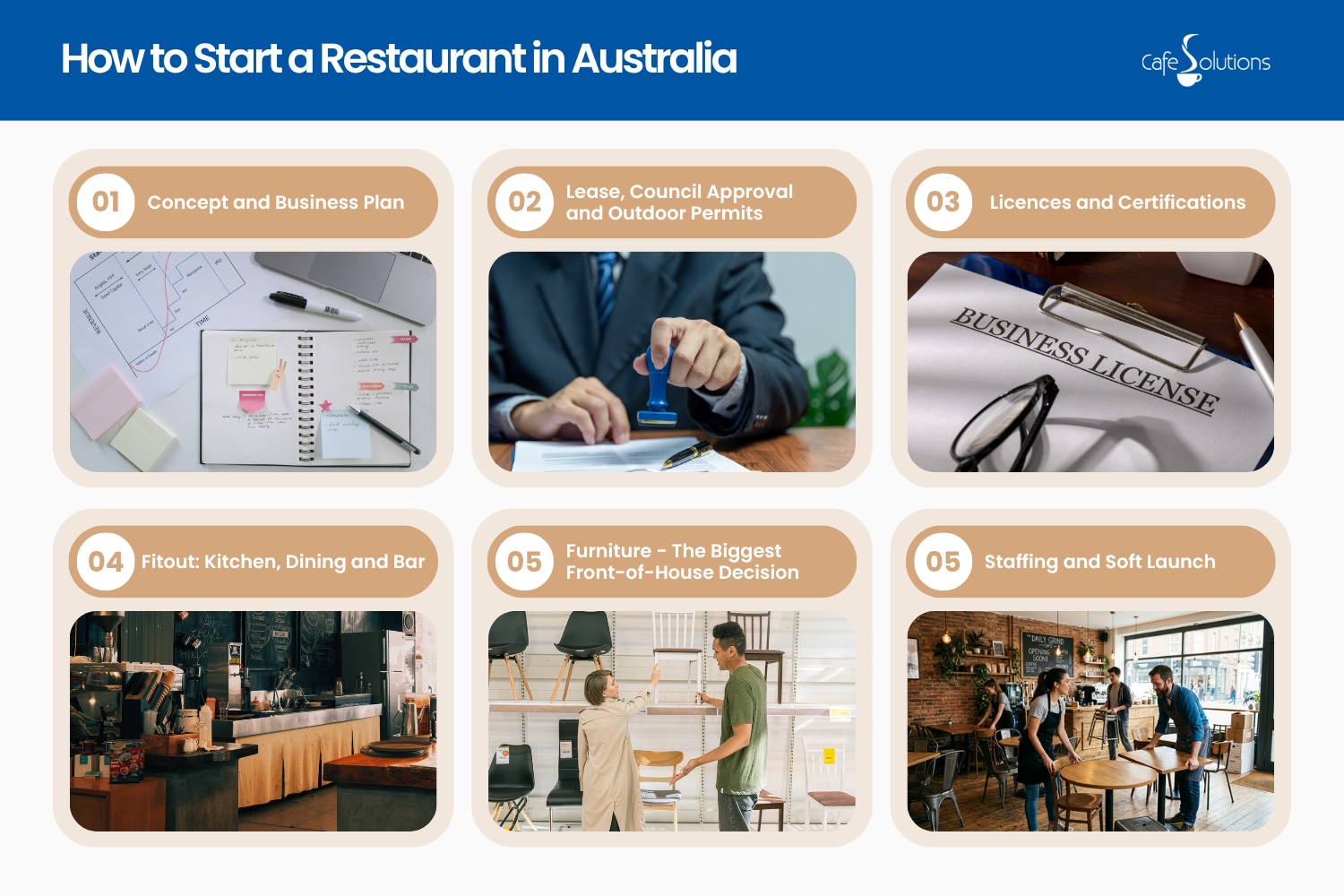
Your restaurant concept should define how the business will trade, not just what food you will serve. Decide on the format, cuisine, target customer, service model, average spend, trading hours, takeaway or delivery role, alcohol service, bar seating, outdoor dining, target cover count, staffing model, fitout standard and furniture durability needs.
A 40-seat neighbourhood restaurant needs a very different kitchen, roster and furniture plan from a 120-seat venue with a bar, alfresco area and private dining room. Your concept sets the commercial logic for every later decision, including rent, fitout cost, furniture budget and opening timeline.
Work out your cover count early
Cover count affects revenue, table sizes, chair quantities, service flow, staff movement and furniture cost. If your target is 70 indoor seats and 20 outdoor seats, you may need more than 90 chairs once you allow for spares, outdoor-rated furniture, accessible seating, bar stools, waiting area furniture and flexible tables for group bookings.
Your business plan should cover the concept, target market, competitor review, menu direction, pricing assumptions, revenue forecast, startup budget, labour forecast, rent assumptions, fitout budget, furniture budget, supplier plan, marketing plan, soft launch plan and cash reserve. If the numbers do not work on paper, they will not improve once rent, wages, food costs and loan repayments begin.
Phase 2: Lease, Council Approval and Outdoor Permits
Your lease can shape the entire restaurant, so check whether the premises can legally and practically support the venue before signing. An empty shop is not automatically suitable for restaurant use. You may need development approval, a change of use, food premises approval, exhaust upgrades, plumbing upgrades, grease trap access, toilet compliance, accessibility compliance, waste storage and outdoor dining permission.
Check the premises before signing
Review the current approved use, zoning, development application requirements, existing food approvals, kitchen exhaust capacity, gas, water, electrical supply, grease trap access, trade waste requirements, toilets, accessibility, waste storage, noise limits, outdoor seating potential, liquor licence suitability, heritage restrictions and signage rules.
A cheap site can become expensive if it needs major mechanical, hydraulic or building works. Ask your designer, builder, certifier, council contact and solicitor to review the premises before you commit.
Lease negotiation points
Restaurant leases involve more than rent and bond. Check the lease term, renewal options, rent reviews, outgoings, fitout contribution, rent-free period, permitted use, liquor licence conditions, outdoor dining permissions, assignment rights, personal guarantees, demolition clauses, relocation clauses, trading hour limits and shopping centre rules where relevant.
Pay close attention to the make-good clause. It may require you to remove fitout works and return the premises to a set condition at the end of the lease, which can be costly if you have installed exhaust, plumbing, bars, banquettes, counters, flooring, wall finishes or custom joinery.
Outdoor dining and alfresco permits
If outdoor seating is part of your revenue plan, confirm the permit process early. Councils may require public liability insurance, a site plan, pedestrian clearance, furniture details and ongoing fees. Outdoor furniture also needs to handle weather, cleaning, movement and heavy daily use.
Phase 3: Licences and Certifications
Restaurant licensing in Australia changes by state, territory, council, business activity and service model. Treat this as a planning reference, not legal advice. Confirm your exact obligations with your local council, state food authority, liquor authority and professional adviser before trading.
Food business registration
Most restaurant operators need to register or notify their food business with the local council or relevant state authority. You may need to submit plans, confirm food safety arrangements and pass inspections before opening.
Common requirements include food business registration, food premises inspection, a food safety supervisor, food handler training, food safety records, temperature control procedures, cleaning and sanitising systems, pest control, waste management and allergen controls.
Food safety supervisor and food handler training
Restaurants handling unpackaged, potentially hazardous ready-to-eat food should plan for food safety supervisor and food handler training obligations. This applies to many venues preparing meat, seafood, eggs, dairy, cooked rice, pasta, cut fruit, ready-to-eat dishes and foods requiring temperature control.
Confirm who your food safety supervisor will be, what training they need, whether their certificate is current and how food handlers will be trained. Set up records for staff training, temperature checks, cleaning, receiving, allergens and cross-contamination before opening.
Liquor licensing reference table
If you plan to sell alcohol, your liquor licence can affect layout, bar design, signage, staff training, approved service areas, trading hours and outdoor dining.
| State or Territory | Liquor Licensing Authority | Planning Note |
|---|---|---|
| NSW | Independent Liquor & Gaming Authority and Liquor & Gaming NSW | Check on-premises licence options for restaurants. |
| Victoria | Liquor Control Victoria | Check restaurant and cafe liquor licence requirements. |
| Queensland | Office of Liquor and Gaming Regulation | Check whether liquor is subsidiary to meals or part of a broader bar model. |
| South Australia | Consumer and Business Services | Check restaurant and catering liquor licence conditions. |
| Western Australia | Racing, Gaming and Liquor | Check licence type, approved areas and manager requirements. |
| Tasmania | Commissioner for Licensing, Liquor and Gaming Branch | Check licence category and operating conditions. |
| ACT | Access Canberra | Check whether your premises needs a liquor licence or permit. |
| Northern Territory | Director of Liquor Licensing / Liquor Commission | Check restaurant authority and licence conditions. |
For more detail, read our guide to liquor licensing in your cafe, bar and restaurant.
RSA training
Responsible Service of Alcohol training is generally required for staff who sell, serve or supply alcohol. Requirements vary by state and territory, so confirm whether your staff need local RSA training, refresher training or approved manager qualifications.
Phase 4: Fitout: Kitchen, Dining and Bar
The fitout is where many restaurant budgets blow out. Plan this phase with your builder, designer, certifier, kitchen consultant and council requirements in mind. Cafe Solutions is not a full commercial kitchen designer, but we do supply key fitout items that support restaurant operations, including stainless steel benches, dining furniture, bar furniture and commercial seating.
Commercial kitchen fitout
The kitchen must support food safety, speed, cleaning and staff movement. Plan clear zones for receiving, dry storage, cold storage, freezer storage, prep, cooking, plating, dishwashing, handwashing, cleaning chemicals, waste and staff access.
Stainless steel is widely used because it is durable, easy to clean and suited to food preparation areas. For prep, plating, storage support and back-of-house work zones, browse our stainless steel benches range.
Check that there is enough bench space, safe movement between prep and cooking areas, separation between raw and ready-to-eat workflows, practical refrigeration access, enough dry storage, suitable handwash basin placement, adequate ventilation and bin access that does not block service flow. Do not cut kitchen benching too aggressively. A cramped kitchen slows service and increases pressure on staff.
Dining room fitout
The dining room controls capacity, comfort, noise, staff movement, table turnover and customer experience. Plan the entry, host point, waiting area, circulation paths, table spacing, chair pull-out clearance, accessible routes, POS position, water stations, table combinations, lighting, acoustics, outdoor access, toilets and emergency exits.
The aim is to fit enough covers to support revenue without making the room hard to serve. Overcrowding can reduce comfort and slow staff down, while under-seating the room can make it harder to cover rent and wages. A flexible mix of two-person tables, four-person tables and movable table bases usually gives operators more booking flexibility.
Our commercial dining tables guide can help you compare table sizing, materials and layout before ordering.
Bar setup
If your restaurant includes a bar, decide whether it is a service bar, customer seating area or major revenue centre. A service bar needs speed, storage, refrigeration, glassware access and staff efficiency. A customer-facing bar also needs comfortable stools, foot support, lighting, counter overhang and enough working space behind the bar.
Plan the counter length, number of stools, stool height, spacing, glasswasher location, ice storage, garnish area, POS access, back bar display, underbar refrigeration, lighting, noise and queue position. If bar seating is part of the venue, browse our restaurant stools and bar furniture before finalising counter height and spacing.
Phase 5: Furniture – The Biggest Front-of-House Decision
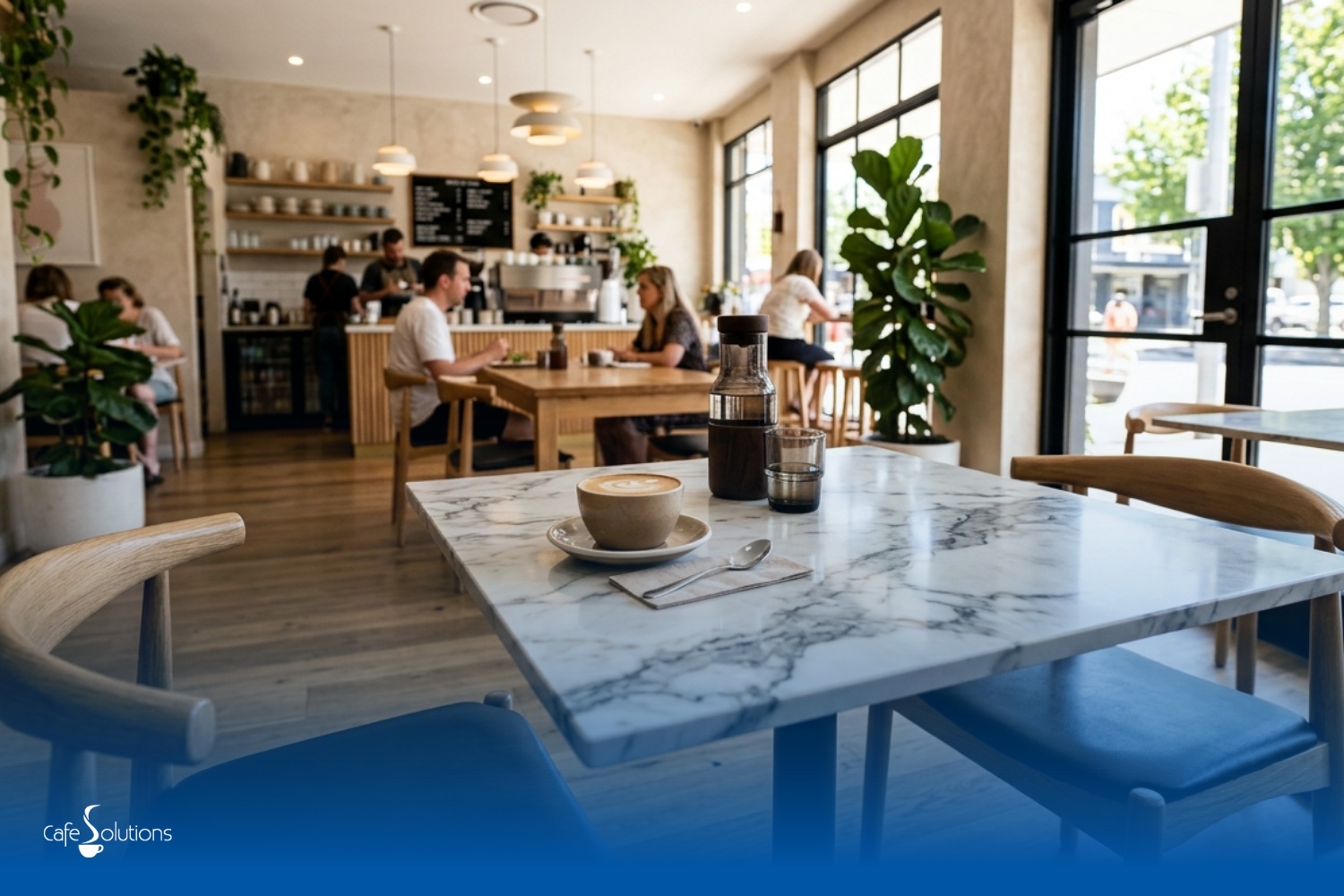
Furniture is one of the most visible fitout decisions, but it is also operational. It affects cover count, comfort, cleaning, durability, staff movement, replacement costs and the customer’s impression of value. This is where operators should slow down and plan properly.
How to calculate your furniture budget
Start with a simple formula:
Cover count x furniture cost per seat = front-of-house furniture budget.
For commercial-grade restaurant furniture, a typical planning range is around $150 to $400 per seat for furniture only. The final figure depends on chair type, table size, tabletop material, table base style, outdoor requirements, bar stools, custom finishes and spare stock.
| Venue Type | Typical Furniture Cost Per Seat | AFRDI Note |
|---|---|---|
| Cafe or casual daytime venue | $150 to $250 per seat | AFRDI tested options can be useful where furniture has heavy daily use. |
| Casual restaurant | $200 to $350 per seat | Durability matters because chairs and tables are used across lunch, dinner and cleaning cycles. |
| Premium or fine dining restaurant | $300 to $400+ per seat | Comfort, finish quality and long-term presentation become more important. |
A 70-seat casual restaurant using a $200 to $350 per seat range should allow around $14,000 to $24,500 for dining furniture before adding bar stools, outdoor furniture, spares or custom pieces. This does not include kitchen equipment, joinery, lighting, flooring, ventilation, plumbing or other fitout costs.
For a deeper cost breakdown, read our guide to restaurant tables and chairs costs.
Why AFRDI testing matters
Restaurant furniture is used harder than domestic furniture. Chairs are moved, dragged, cleaned, stacked, knocked, leaned on and used by hundreds of customers each week. A chair that looks suitable in a showroom may not be suitable for commercial hospitality use.
AFRDI testing gives operators an independent durability and performance signal. It can help with decisions around commercial suitability, warranty confidence, long-term replacement cost and daily-use durability. When reviewing furniture, check whether it is commercial-grade, AFRDI tested, weight-rated, easy to clean, suitable for indoor or outdoor use, supported by a clear warranty and available for reorder later.
Cafe Solutions has a dedicated AFRDI tested furniture range, and you can also read our guide to Australian furniture standards (AFRDI).
Dining chairs and table selection
Restaurant chairs should match the service model. A fast casual venue may prioritise durability, cleaning and easy movement. A full-service restaurant may need longer-sit comfort, stronger styling and a more substantial frame.
When choosing restaurant chairs, check seat comfort, back support, frame strength, weight, stackability, cleaning, floor protection, indoor or outdoor suitability, width, armrest design, finish durability and replacement availability. Chair width is especially important because wider chairs can reduce cover count in a tight dining room.
Tables should match menu style and plate count. A restaurant serving share plates, wine, sides and larger dinner plates needs more table surface than a quick lunch venue. If your menu uses larger plates or shared dishes, read our guide to the plate sizes you need before locking in table dimensions.
Browse our cafe tables, restaurant table tops and restaurant table bases to compare combinations.
Table tops and bases
Commercial restaurant tables are often selected as a top and base combination. This gives you more control over size, material, stability, cleaning, replacement and layout flexibility.
For table tops, check size, shape, edge profile, heat resistance, scratch resistance, water resistance, cleaning requirements, finish, indoor or outdoor suitability, weight and base compatibility. For table bases, check stability, floor type, base spread, weight, height, adjustable feet, outdoor suitability, top compatibility and ease of cleaning around the base.
A common mistake is pairing a large or heavy tabletop with a base that is too small. This can cause wobbling, tipping risk and customer frustration.
Bar furniture and stools
Bar stools need careful planning because the wrong height, frame or spacing can make the bar uncomfortable. Check seat height, counter height, footrest position, backrest style, swivel or fixed design, upholstery, cleaning, weight, stability, stool spacing and indoor or outdoor suitability.
Backless stools can save space and suit shorter visits. Stools with backrests are usually better for longer dining or drinking sessions. Upholstered stools can improve comfort but need more cleaning and maintenance planning.
Lead times for when to order restaurant furniture
Do not leave furniture until the final week before opening. A safe planning window is usually 4 to 8 weeks before opening and longer for large quantities, custom finishes, outdoor furniture or matching table and chair combinations.
Delays can come from stock availability, freight timing, supplier backlogs, custom finishes, large order quantities, site access issues, late building works and last-minute layout changes. A furniture delay can affect staff training, photography, bookings, soft launch and opening week revenue.
Furniture maintenance planning
Restaurant furniture lasts longer when staff know how to clean, move and check it properly. Set a daily wipe-down process, use approved cleaning products, check screws weekly, inspect table wobble, monitor floor glides, protect upholstery, store outdoor furniture correctly, follow stack limits and train staff to move furniture without dragging it.
Our full guide to cafe maintenance is useful for building a maintenance routine before furniture damage becomes expensive.
Phase 6: Staffing and Soft Launch
Start staffing before the venue is finished. Waiting until the fitout is complete can leave too little time for hiring, training, menu testing and service rehearsal.
A restaurant team may include a head chef, sous chef, cooks, kitchen hands, a restaurant manager, supervisors, wait staff, bartenders, hosts, baristas, dishwashing staff, cleaners, a book-keeper or accountant and marketing support. Confirm the correct award, pay rates, penalty rates, superannuation, payroll setup, contracts, work rights, training and workplace health and safety obligations before opening.
Train around the actual floor plan
Training works best when staff can practise in the real space. Once furniture is installed, rehearse greeting, seating, table movement, ordering, plate delivery, clearing, spill handling, bar seating, outdoor furniture movement, POS use, complaint handling, allergen explanations and opening and closing procedures.
Customer service has a direct effect on hospitality performance. Read our guide on customer service impact on cafe businesses for more practical service considerations.
Run a soft launch
A soft launch lets you test the restaurant before full public trading. Invite a controlled group, limit the menu if needed and collect direct feedback.
Use the soft launch to test bookings, table spacing, kitchen timing, plate presentation, staff movement, furniture comfort, bar flow, payments, cleaning, noise, menu pricing, customer feedback and opening and closing checklists. It is better to find a layout issue, stool height problem or service bottleneck with 30 invited guests than during a fully booked Saturday night.
Cafe Solutions can help with the furniture and front-of-house planning side of that process. Browse our restaurant chairs, cafe tables, restaurant table tops, restaurant table bases, restaurant stools and hospitality furniture ranges to start planning your fitout.
If your opening date is already on the calendar, request a Cafe Solutions catalogue or contact our team before finalising your floor plan. The earlier you plan your furniture, the easier it is to protect your layout, budget and launch timeline.
FAQs on How to Start a Restaurant in Australia
How much does it cost to start a restaurant in Australia?
A realistic 2026 planning range is around $250,000 to $1 million or more. A smaller restaurant in an existing food premises may sit closer to the lower end, while a larger full-service restaurant with major kitchen works, bar fitout, custom finishes, liquor licensing and higher working capital can exceed $1 million.
What is the biggest expense when opening a restaurant?
The biggest expense is usually the fitout. This can include kitchen works, exhaust, plumbing, electrical upgrades, flooring, walls, lighting, joinery, bar construction, furniture, signage and compliance-related works. Kitchen equipment and working capital are also major costs.
What chairs do restaurants use?
Restaurants use commercial-grade chairs designed for frequent hospitality use. Common options include timber chairs, metal chairs, bentwood-style chairs, upholstered chairs, stackable chairs, outdoor chairs and AFRDI-tested chairs. The right choice depends on service style, comfort needs, cleaning, durability and layout.
How long does restaurant furniture last?
Commercial restaurant furniture can last several years when it is suitable for hospitality use and maintained properly. Lifespan depends on frame material, construction quality, indoor or outdoor use, cleaning products, customer volume and staff handling. AFRDI tested furniture can provide a stronger durability signal when choosing chairs and tables.
How much do restaurant chairs cost in Australia?
Restaurant chairs in Australia commonly range from around $80 to $250+ per chair, depending on material, design, upholstery, indoor or outdoor suitability, testing and commercial quality. As a full furniture budget, many operators plan around $150 to $400 per seat when chairs, tables, bases and related items are included.
Back to Top: How to Start a Restaurant in Australia: The 2026 Operator’s Furniture & Fitout Checklist